|
|
|
|
| |
|
|
|
|
|
|
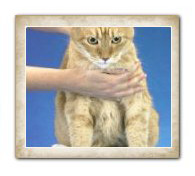
If
possible start training your cat to have her claws trimmed
as a kitten. Gently stroke your cat's paws often, getting
her used to having her paws held before you attempt
trimming. Be sure to reward your cat with a special
food treat-one that she receives only during claw trimming
or some other grooming procedure-during or immediately
after trimming. The best time to trim your cat's claws
is when she is relaxed or sleepy. Never try to give
a pedicure right after a stressful experience or an
energetic round of play.
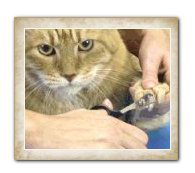
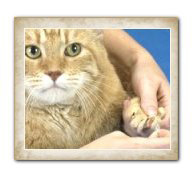
Your cat should be resting comfortably on your lap,
the floor, or a table. Hold a paw in one hand and press
a toe pad gently to extend the claw. Notice the pink
tissue (the quick) on the inside of the claw. Avoid
the quick when you trim the claw; cutting into it will
cause pain and bleeding Remove the sharp tip below the
quick (away from the toe), clipping about halfway between
the end of the quick and the tip of claw. If your cat
becomes impatient, take a break and try again later. |
|
|
|
|
Even if you can clip only a claw or two a day, eventually
you'll complete the task. (Because cats do little damage
with their rear claws and do a good job of keeping them
trim themselves-by chewing them-many cat owners never
clip the rear claws. Others trim their cats' rear claws
three or four times a year or have them done by their
veterinarian or a professional groomer.)
Many people hold the clippers at right angles to the
nail, thus cutting across the nail. This tends to make
the nail more subject to splitting or fraying. It is
better to hold the clippers in a vertical position--that
is, up and down, so that the claw is trimmed from bottom
to top instead of across the nail. This position help
prevent splitting.
If you accidentally clip into the quick, don't panic.
The claw may bleed for a moment, but it will usually
stop very quickly. Soothe your cat by speaking softly
to her and stroking her head. If the bleeding hasn't
stopped after a minute or so, touch a styptic pencil
to the claw end or pat on styptic powder to help staunch
the bleeding. |
|
|
|
|
|
|
|
How often
you need to clip your cat's claws depends somewhat on
how much of the tip you remove, but usually a clipping
every ten to fourteen days will suffice. If your cat
absolutely refuses to allow you to clip his or her claws,
get help from your veterinarian or a professional groomer.
Notice the pink tissue (the quick) on the inside of
the claw. Avoid the quick when you trim the claw; cutting
into it will cause pain and bleeding Remove the sharp
tip below the quick (away from the toe), clipping about
halfway between the end of the quick and the tip of
claw.
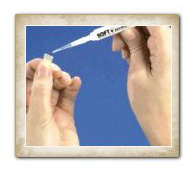
Special claw trimmers (two types are shown) are available
from veterinarians or pet supply stores, but sharp nail
clippers for humans work just as well. Keep a styptic
(astringent) pencil or powder on hand in case you accidentally
clip into the quick and bleeding hasn't stopped within
a couple of minutes.
|
|
|
|
|
|
|
|
|
|
|
|
|
|
|
|
39685 Sierra Dr., Three Rivers, CA 93271
|
|
|
|
|
|
|
|
|